


October 28, 2026
Vygotsky’s and Piaget’s Ideas in Contemporary Research and Practice: Key Takeaways from a Roundtable Marking the Scholars’ Anniversaries
International Scientific and Practical Conference «Philosophical, Psychological and Pedagogical Heritage and Modernity: Commemorating the Anniversaries of L. S. Vygotsky and J. Piaget» took place on October 22.
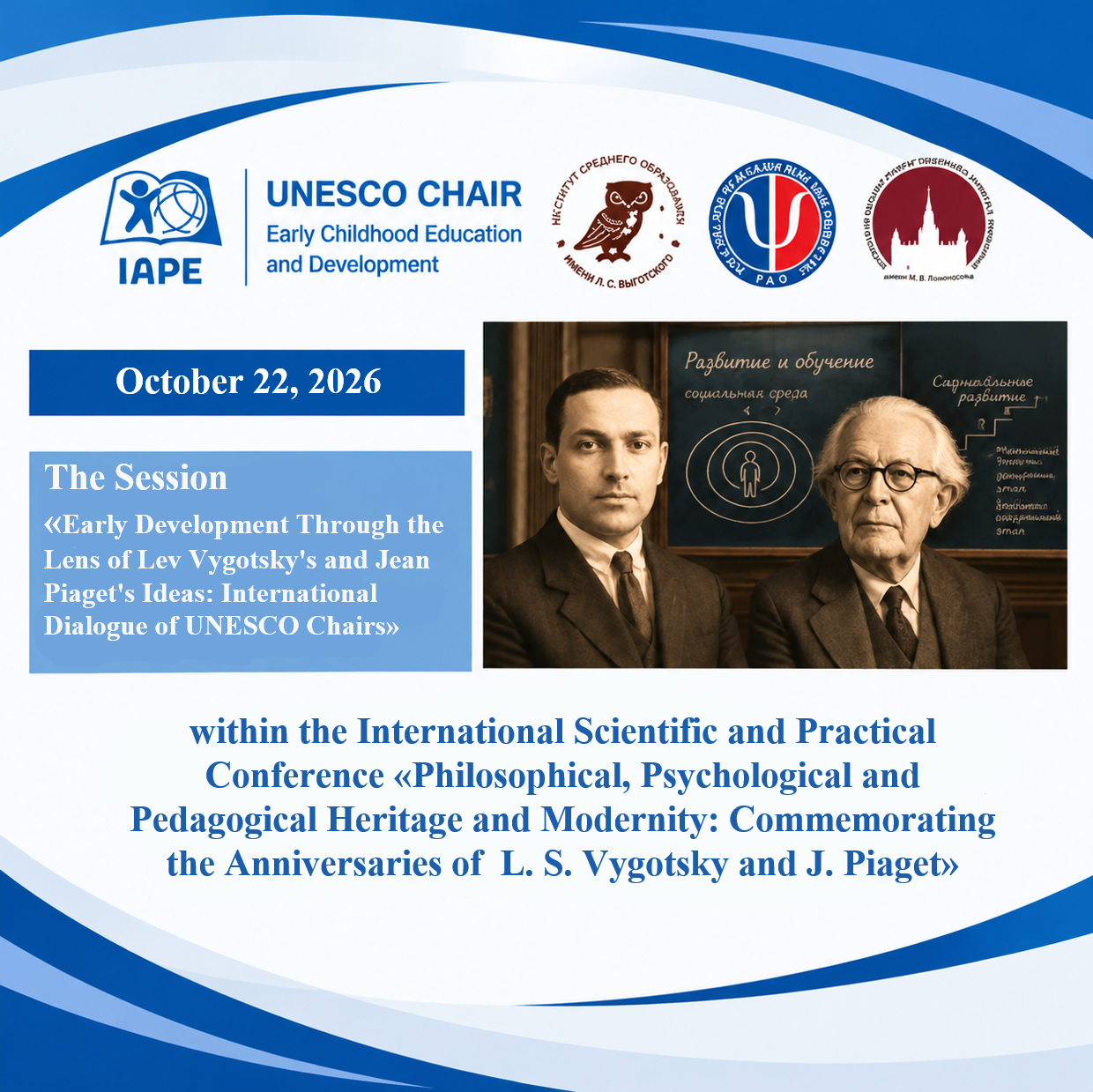
. A key part of the programme was the roundtable discussion « Early Development Through the Lens of Lev Vygotsky's and Jean Piaget's Ideas: International Dialogue of UNESCO Chairs».
The session was moderated by Alexander Veraksa, Head of the Department of Educational Psychology and Pedagogy at the Faculty of Psychology of Lomonosov Moscow State University, Doctor of Psychology, Academician of the Russian Academy of Education, and member of the UNESCO Chair on Early Childhood Education and Development.
Alexander Veraksa opened the session by thanking the Commission of the Russian Federation for UNESCO for its support of the event and outlining the central objective of the meeting: to demonstrate how the ideas of these two eminent scholars are being put into practice today in educational settings and research.
Key ideas presented by the speakers
Muhammad Nurunnabi (Prince Sultan University, Saudi Arabia; Adviser to the University President, UN Ambassador for the Sustainable Development Agenda, and member of the UNESCO Commission on Education and Sustainable Development) examined the impact of digitalisation on early childhood development. He presented data on the increase in screen time among children under the age of eight, statistics on access to early childhood education across different regions, and the relationship between digital practices and academic outcomes.
The speaker emphasised that the theories of L. S. Vygotsky and J. Piaget provide a framework for establishing criteria to evaluate digital tools. It is essential to preserve the central role of play, take the zone of proximal development into account, and ensure that adults remain actively involved as mediators. He placed particular emphasis on the need to safeguard children when they use technology and to systematically develop key competencies—including empathy, collaboration, and agency—in the context of the Sustainable Development Goals.
Ig Ibert Bittencourt (Federal University of Alagoas, Brazil; Chairholder of the UNESCO Chair on Artificial Intelligence in Education) explored the links between the theories of L. S. Vygotsky and J. Piaget and the development of artificial intelligence in education. He demonstrated how Vygotsky’s approach and Piaget’s constructivism laid the groundwork for contemporary intelligent tutoring systems and learning analytics.
The speaker highlighted the risks associated with generative AI, particularly the potential erosion of critical thinking and emotional manipulation. He called for an approach that combines social constructivism with a humanistic perspective, placing learners’ well-being and autonomy at the forefront.
Dhanya Chandran (Amrita Institute of Medical Sciences, India; Head of the Department of Clinical Psychology and member of the UNESCO Chair on Experiential Learning for Sustainable Innovation and Development) focused on sociocognitive development and the acquisition of academic skills. She explored the role of language and self-regulation in higher mental functions according to L. S. Vygotsky and demonstrated how social and emotional skills influence academic achievement.
Among the key factors, the speaker highlighted self-discipline, planning, and the ability to regulate one’s own cognitive processes. She also drew attention to the risks of information overload and the pursuit of instant gratification associated with the widespread use of social media and short-form videos.
Anna Teresa Gavian Mariotti (University of São Paulo, Brazil; member of the Scientific Committee of the Centre for Research in Learning Design) addressed the child’s right to play and to be the author of their own thinking. Drawing on Brazil’s educational policy, she demonstrated how Vygotsky’s ideas are being implemented at the institutional level: play is regarded as a fundamental activity that creates a zone of proximal development, while the child is recognised as an active agent and creator of their own thinking.
The speaker stressed the importance of fostering an educational culture that respects children’s initiative and preserves space for free play.
PJ Bengwasan (De La Salle University, the Philippines; representative of the Psychological Association of the Philippines) presented the project “Through the Eyes of Children”, a reflective, experiential model for training play therapists. Drawing on the theories of J. Piaget and L. S. Vygotsky, he described play therapy practices that help children express their emotions, make sense of conflicts, and explore alternative patterns of behaviour.
The findings of a longitudinal study demonstrated a reduction in aggressive behaviour among children, with the positive effects sustained after the sessions had ended. An important component of the programme was the training of future specialists through immersive experiences and reflection on their own experiences.
Alexander Veraksa presented the findings of a Russian research project conducted by Lomonosov Moscow State University and the Federal Scientific Centre for Psychological and Interdisciplinary Research: an emotional development program for children titled «Looking, Seeing, Discussing». The program is based on L. S. Vygotsky’s concepts regarding «lived experience»—and J. Piaget’s account of the stages of emotional development.
As part of the programme, preschool and primary school children discuss emotions depicted in paintings by Russian artists. Research findings confirmed a statistically significant improvement in children’s ability to understand emotions.
Key takeaways and future prospects
The roundtable participants demonstrated how the intellectual legacy of L. S. Vygotsky and J. Piaget continues to inspire researchers and practitioners around the world, from the development of educational technologies to emotional development programmes and play therapy practices.
As the moderator noted, the approaches presented open up new opportunities for international collaboration and for further translating the scholars’ ideas into contemporary education systems.