

June 9, 2026
UNESCO Chairs Took Part in The 6th International Psychological Forum "Child in the Digital World"
The 6th International Psychological Forum "Child in the Digital World," a major scientific event in the field of child development and education, was held on June 1-2, 2026. The Forum traditionally brought together over 7,000 psychologists, educators, anthropologists, medical professionals, journalists, linguists, developers of digital educational products, and other experts studying childhood.
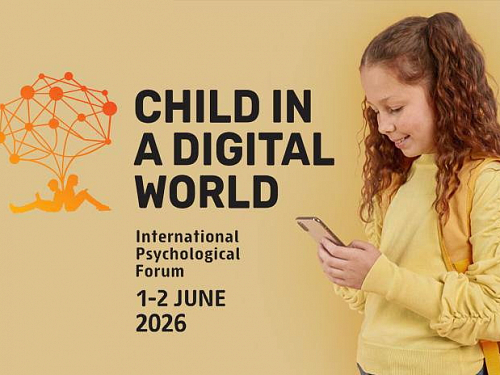
The 6th International Psychological Forum "Child in the Digital World," a major scientific event in the field of child development and education, was held on June 1-2, 2026. The Forum traditionally brought together over 7,000 psychologists, educators, anthropologists, medical professionals, journalists, linguists, developers of digital educational products, and other experts studying childhood.
The Forum was organized by the Federal Scientific Center for Psychological and Interdisciplinary Research, together with the Faculty of Psychology at Lomonosov Moscow State University, and the Russian Psychological Society. The Forum was held with the support of the Ministry of Science and Higher Education of the Russian Federation, the Committee on Science, Education, and Culture of the Federation Council of the Federal Assembly of the Russian Federation, and the Commission of the Russian Federation for the United Nations Educational, Scientific, and Cultural Organization (UNESCO).
The UNESCO Chair of Early Childhood Education and Development played a key role in expanding international cooperation by coordinating the participation of various UNESCO chairs in the Forum. As a result of these efforts, five UNESCO chairs from Bangladesh, South Africa, Cameroon and Mexico participated in this year's event.
The Forum was moderated by Alexander Veraksa, Head of the Department of Educational Psychology and Pedagogy in the Faculty of Psychology at Lomonosov Moscow State University, Deputy Director of the Federal Scientific Center for Psychological and Interdisciplinary Research, Vice President of the Russian Psychological Society, and Full Member of the Russian Academy of Education; Anna Leybina, Associate Professor at the Faculty of Psychology of Lomonosov Moscow State University; and Apollinaria Chursina, Research Fellow of the Faculty of Psychology at Lomonosov Moscow State University and the Federal Scientific Center for Psychological and Interdisciplinary Research.
Yury Zinchenko, Dean of the Faculty of Psychology at Lomonosov Moscow State University, Director of the Federal Scientific Center for Psychological and Interdisciplinary Research, President of the Russian Psychological Society, Full Member of the Russian Academy of Education, and Corresponding Member of the Russian Academy of Sciences, addressed the Forum participants with a welcoming speech. In his address, he noted the importance of expanding the Forum's geographic reach and the participation of experts from Angola and Bangladesh in this year's dialogue on childhood. Lilia Gumerova, Chairwoman of the Federation Council Committee on Science, Education, and Culture of the Federation Council of the Federal Assembly of the Russian Federation, emphasized that the diversity of expert opinions from representatives of various fields of science speaking at the Forum provides a comprehensive approach that addresses critical issues of digital education. Elena Galaktionova, Executive Secretary of the Commission of the Russian Federation for UNESCO, noted that the efforts of the Forum's specialists and researchers help the practitioners to choose the right paths for organizing the digital environment for the harmonious development of children. Maxim Dreval, Director General of the Russian Society "Znanie," drew attention to the practical developments presented at the Forum, which help develop the skills and abilities necessary for the younger generation in the new digital reality. In his welcoming address, Andrew Zamani, President of the Pan African Psychology Union, emphasized the key role of international cooperation in preventing alarming trends in the widespread use of electronic devices. Jorge Enrique Torralbas Oslé, President of the Cuban Psychological Society, Young Associate Member of the Cuban Academy of Sciences, Professor and Vice Dean of the Psychology Department at the University of Havana, highlighted the importance of bringing together specialists from various fields and schools of psychology to address topical issues of preserving the values of modern childhood, and called for building bridges of cooperation and friendship.
Forum participants presented data demonstrating that the value of digital technologies is focused on preserving and strengthening the basic mechanisms of child development—real action, social interaction, and voluntary regulation. Jing Zhao (Associate Professor at the School of Psychology at Capital Normal University) reported data showing that gamified attention training effectively improves reading in children with dyslexia and reduces ADHD symptoms. However, a sustainable effect is achieved only with the involvement of an adult who organizes and conceptualizes the game activity. In turn, Patrik Drid (Dean of the Faculty of Sport and Physical Education at the University of Novi Sad, International Judge of the Highest Category in Judo and Sambo, Member of the European Sambo Federation) emphasized that phygital games contribute not only to the development of physical functions, through the development of coordination and general health, but also improve cognitive skills and social interaction through teamwork. Ella Xuemei Cao (Universiti Sains, Malaysia) noted that teenagers are actively using generative AI for learning, but parents and teachers have not yet developed effective strategies to support this process, which creates the risk of hindering cognitive development. Andik Matulessy (Associate Professor at University of 17 Agustus 1945 Surabaya, President of the Indonesian Psychological Association, President of the ASEAN Regional Union of Psychological Societies) drew attention to the need for modern legislative initiatives requiring providers to filter harmful content and create complaint mechanisms.
In the section organized by the Russian Committee of the World Organization for Preschool Education under the auspices of UNESCO (OMEP), participants discussed how innovative pedagogy and the cultural code method help introduce preschoolers to fine arts (Matteo Corbucci, National President of the Committee of the World Organization for Preschool Education (OMEP) in Italy), and also touched upon issues of sustainable development and the fundamental role of early experience in further human development (Nektarios Stellakis, Associate Professor at the University of Patras, Honorary Member of the World Organization for Preschool Education under the auspices of UNESCO (OMEP, Greece). Attention was also paid to the socio-political analysis of the use of ICT (Joy Tunamau Kiese, Provincial Coordinator of the Agency for the Promotion of Education in Central Congo and Delegate of the French-speaking Commission of OMEP World), as well as the experience of implementing specialized projects that contribute to the strategic goals of UNESCO (Larisa Shevchenko, President of the Russian Committee of OMEP, Full Member of the Russian Municipal Academy).
Researchers from Vietnam (Nguyen Thi Hai, Deputy Dean of the Faculty of Psychology and Educational Sciences at Dai Nam University) found that parental care and open dialogue contribute to the development of self-regulation in adolescents, while strict restrictions have no direct link to psychological well-being. The year of Russian-Vietnamese cooperation in science and education was also marked by a report by Pham Thi Tuc Oanh and colleagues (Dai Nam University), who, in an analysis of the digital activity of Vietnamese adolescents, showed that consuming short videos does not directly harm mental health, it happens rather indirectly, through the fear of missing out, which leads to social media addiction, which, in turn, leads to psychological distress. Among numerous studies on the role of family in the digital experiences of children and adolescents, a report by Abbas Firoozabadi from Ferdowsi University (Iran) was also presented. His study demonstrated that if parents simply forbid their children from watching disturbing news, fear, and anxiety only intensify; but if they explain and discuss what they've seen, it acts as an emotional anchor, helping a child to remain calm. Tamara Gordeeva (Lomonosov Moscow State University, Russia) and Oleg Sychev (Altai State Pedagogical University, Russia) confirmed using a sample of nearly six thousand schoolchildren that warm and supportive family relationships are directly linked to adolescent life satisfaction, while spending too much time online, especially gaming, is actually detrimental, with girls being more vulnerable. Therefore, digital parenting is only beneficial when it is built on support, dialogue, and shared activities, rather than prohibitions—and both child and adult are equally important in this process. The report by Vania Madalena José Filipe and Creusa Yolanda Albino Policarpo (Catholic University of Angola) also discussed the need of control and mediation by parents and caregivers, as it is necessary to strengthen measures to achieve a balance between screen time and other child activities to reduce excessive screen time in the evenings. Alpana Vaidya (Professor and Head Department of Psychology at Symbiosis College of Arts and Commerce, India) highlighted that children are being introduced also to social media platforms at an earlier age, often under minimal supervision. This trend is particularly alarming given that approximately a third of today's preschoolers exhibit signs of speech impairment, and approximately half of them experience difficulties mastering their native language, emphasized Tatyana Batysheva (Director of the Research and Practice Center for Child Psychoneurology, Moscow Health Department, Honored Medical Doctor of the Russian Federation, Member of the Presidium of the All-Russian Society of Neurologists, Chief Pediatric Specialist of the Russian Ministry of Health).
2026 is a special year for psychologists and educators around the world, as it marks the 130th anniversary of the birth of the eminent psychologist Lev Vygotsky. A special thematic section dedicated to modern child cultural-historical psychology included a discussion on the role of parents and educators in conceptualizing new patterns in the social situation of development in children and adolescents. Joseph Seyram Agbenyega, Full Professor at the Emirates College of Advanced Education (UAE), noted that adult-organized and guided children's use of digital devices can become part of their zone of proximal development. Joaquim Quintino-Aires, Founder and Director of the Vygotsky Institute (Portugal), emphasized that the digital world is new both for children and adults, and the key issue in raising children in a digital world is that parents acquire the necessary skills and abilities to use digital devices as developmental tools. Hasina Ebrahim, Professor at the University of South Africa and UNESCO Co-chair for Early Childhood Education, Care and Development, spoke about the development of digital citizenship as a new element of a child's self-awareness. Usha Kiran Subba, Professor at Tribhuvan University (Nepal) and President of the Nepal Psychological Society, focused on comparing traditional and digital means of developing children's reading skills.
As part of the Forum's sections, experts from Latin America presented research results in psychology, education, medicine, social policy, and linguistics. José Antonio Flores Farfán, Senior Researcher at the Center for Research and Higher Education in Social Anthropology (CIESAS), Linguapax representative in Latin America (Mexico) presented a project aimed to preserve indigenous languages in Mexico through author-produced books using AR technology. A presentation by Carol Rivero Panaqué and Karla Lucía Guerrero Suárez (Pontifical Catholic University of Peru) presented the results of the development of an educational robot for bullying prevention: the robot, as an interactive mediator, allows children to safely experience the dilemmas associated with communicating with strangers. Aimée Vega Montiel, Co-Chair of the UNESCO UNITWIN Network for Gender Issues (Mexico) highlighted the wide range of issues related to digital violence against children and outlined ways for cooperation between intergovernmental organizations, developers, and relevant experts. Lucía Bugallo (Researcher at the Patagonian Institute of Humanities and Social Sciences, Comahue National University) used the example of an offline humorous drawing workshop in Argentina to demonstrate how shared physical space generates play and humor that often remain invisible in digital environments. Michael Pereira da Silva (Faculty of Medicine, Federal University of Rio Grande, Brazil) presented the results of the SmartKids and Smarteens studies on the impact of smartphones on sleep patterns in Brazilian children and adolescents and emphasized the need to stop using digital devices at least an hour before bedtime. Rodrigo Antonio Arroyo Bravo (University of San Sebastián, Chile) provided recommendations for the productive sharing of digital devices between children and parents.
Over two productive days, a wide range of digital childhood issues were addressed: from specific recommendations for parents and teachers to developing new approaches to using digital environments. Representatives from UNESCO Chairs in Bangladesh, South Africa, Cameroon, Mexico, and Russia participated in the Forum. The geographic diversity of the event's participants was living proof of the growing interest in the topic and the willingness to exchange experiences internationally, creating a cohesive community of scholars and practitioners genuinely interested in the well-being of children in the digital world.