

February 24, 2026
Roundtable "The Native Language of Childhood. The Issue of Preserving Native Languages"
On February 20, The International Pedagogical Academy of Preschool Education (IPAPE) hosted a round table dedicated to International Mother Language Day, which was attended by heads and staff of UNESCO Chairs of the Russian Federation within the framework of network interaction, scholars, and practicing teachers.
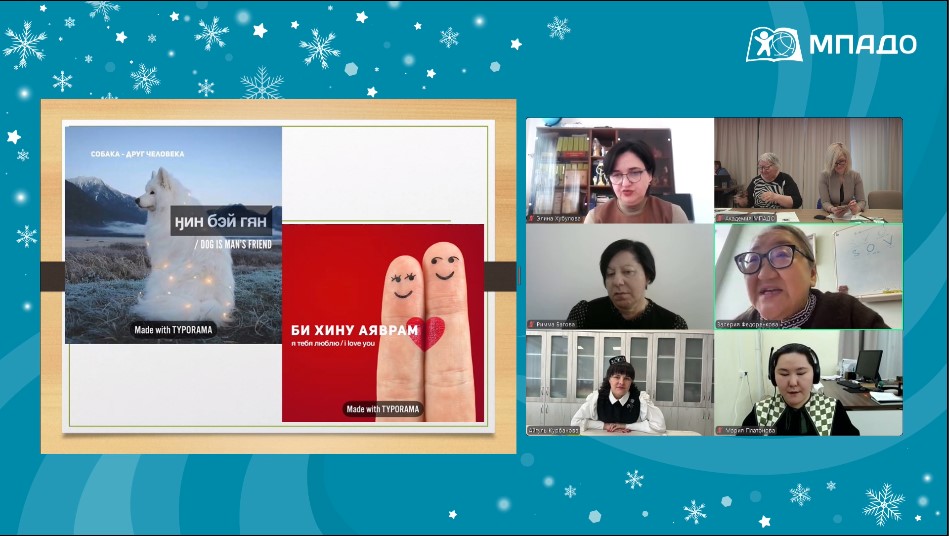
The International Pedagogical Academy of Preschool Education (IPAPE) hosted a round table dedicated to International Mother Language Day, which was attended by heads and staff of UNESCO Chairs of the Russian Federation within the framework of network interaction, scholars, and practicing teachers.
The roundtable was opened by Irina I. Komarova, Vice-Rector for Science, Cand. Sci. (History), Academician of the Russian Municipal Academy, and Member of the working group on the development of the information society in Russia of the Civic Chamber of the Russian Federation. In her welcoming speech, Irina Ilyinichna thanked all participants for gathering together on International Mother Language Day. She noted that each of those present is not only a native speaker but also a leading specialist in their field, working with preschoolers and contributing to their linguistic development.
Irina Ilyinichna then read a welcome letter to the roundtable participants from Nella M. Pruss, National Coordinator of the UNESCO Associated Schools Network in the Russian Federation, Head of the UNESCO Chair, Director of the UNEVOC Centre, President of the University of Management "TISBI." Nella Matveevna emphasized that International Mother Language Day symbolizes friendship and love for culture, and the cultivation of respect for linguistic diversity. "Language is not only a means of communication but also a tool for shaping cultural identity. It is important that children grow up where they can hear and use their native language, aware of its richness from early childhood, and also understand the importance of early language development." She expressed her hope that the round table would become a platform for exchanging ideas and initiatives to support the linguistic environment among preschool children.
Marina A. Krivenkaya, Director of the Center for Regional Studies and Humanitarian-Educational Cooperation at the Institute of Social and Humanitarian Education, Moscow Pedagogical State University (MPSU), and Coordinator of the UNESCO Chair "International Education and Integration of Migrants" at MPSU, also welcomed the participants and noted the importance of preserving languages and cultures from an early age. She invited colleagues to participate in events dedicated to the Days of Slavic Written Language and Culture.
Tatiana V. Savelyeva, Director of the Department for Strategy of Development of Educational Projects at IPAPE, proposed joining a project to develop standardized solutions for kindergarten teachers working in a bilingual environment.
Olga V. Sineva, Cand. Sci. (Philology), Associate Professor of the UNESCO Chair "International (Multicultural) Education and Integration of Migrants," and Scientific Director of the International Competition Project "Bilingua", raised the topic of bilingualism. She focused on the importance of a creative approach to mastering words and the need for systematic tasks to work with lexical collocation.
The next speaker at the round table was Natalia V. Sitnikova, Head of the Department of Polylingual Education, Yakut Branch of the Federal Institute of Native Languages of the Peoples of the Russian Federation. She reported on the recent confirmation of the existence of two closely related languages — Tundra Yukaghir and Kolyma (Forest) Yukaghir. This discovery increases the number of languages in the registry of the Republic of Sakha (Yakutia) by one.
In her presentation, Natalia Vasilievna emphasized the importance of preserving the Yukaghir language, as the number of its speakers continues to decline. However, she noted positive trends among young people, who are beginning to show interest in learning their native language. Clubs and Sunday schools for teaching the Yukaghir language are being actively created in the republic. N.V. Sitnikova also presented educational materials, including a primer and electronic textbooks, developed for children living in Yukaghir settlements. These initiatives are aimed at preserving and developing the Yukaghir language as part of the cultural heritage of the indigenous peoples of Yakutia.
The next speaker was Maria A. Platonova, Chief Bibliographer of the Department of Digital Resource Management at the Center for Digitalization of the Linguistic and Cultural Heritage of the Peoples of Yakutia, National Library of the Republic of Sakha (Yakutia). She spoke about the possibilities of using artificial intelligence services to preserve the Yakut language. In 2024, large-scale projects were launched, resulting in products such as the Voice on LRS platform for collecting voice data, the Istin speech synthesizer, the Sansuru chatbot, and a crowdsourcing system for verifying fragments of automatically recognized text. All these developments are aimed at improving the position of the Yakut language in the digital space.
Valeria S. Fedorenkova, a teacher of the Even language at the Department of Altai Languages, Folklore and Literature of the Institute of the Peoples of the North, Herzen State Pedagogical University, noted in her speech an alarming statistic: the number of Even speakers is decreasing every year. She emphasized the importance of creating special "nests" and camps where children could absorb their native language, at least at an everyday level.
Aigul Kh. Kurbanova, Educator for Tatar Language Instruction at the Combined-Type Kindergarten No. 12 "Little Genius" in the Mendeleevsky Municipal District of the Republic of Tatarstan, shared with the participants two main problems hindering pupils from being fluent in their native language.
According to Aigul Khalimovna, the first problem lies in adults underestimating the importance of passing on their native language to their children. Many parents do not speak Tatar at home, which negatively affects the children's linguistic development. The second problem is the use of outdated approaches by teachers, which do not take into account the characteristics of modern preschoolers and the need for diverse methods to stimulate interest in the native language.
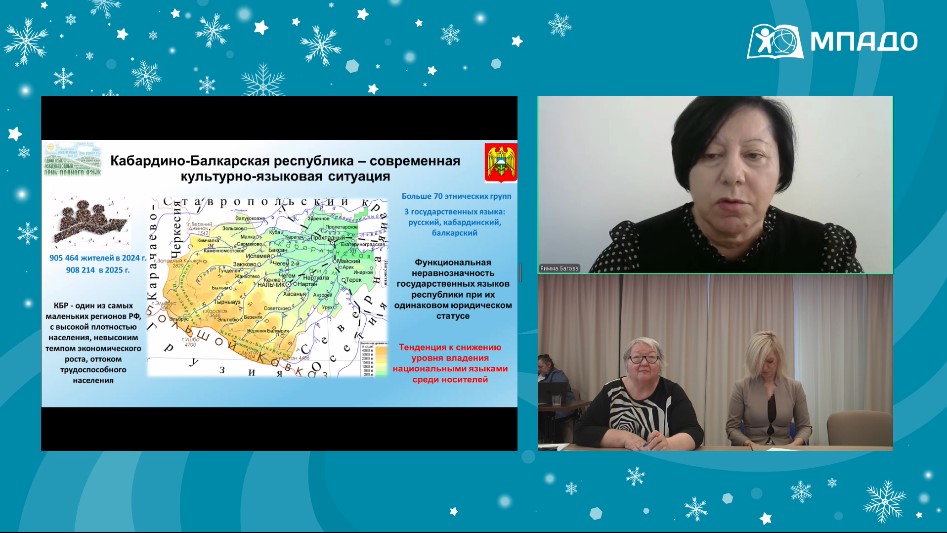
The next speaker at the round table was Rimma Kh. Bagova, Cand. Sci. (Psychol.), Deputy Director of the Institute of Pedagogy, Psychology and Physical Education and Sports, Kabardino-Balkarian State University named after Kh. M. Berbekov. She presented her experience using onomatopoeia, based on the technology of the "space of children's realization." Rimma Khamidbievna noted that the decline in the level of proficiency in national languages among speakers is associated with the diversity of audio content in Russian, as well as the fact that education in state educational institutions begins only in Russian. As a result, parents often prefer to teach their children Russian speech.
Zarina Kh. Tomaeva, Head of the Child Development Center – Kindergarten No. 95 in Vladikavkaz, shared her experience in working to preserve the Ossetian language. One of the steps in solving this problem was the opening of polylingual groups in kindergartens in North Ossetia, where instruction is conducted in Russian and Ossetian. Teachers create a rich linguistic environment, including ethnocultural corners, board games with national themes, and lullabies in the Ossetian language.
At the conclusion of the round table, Rimma M. Kumysheva, Cand. Sci. (Pedagogy), Associate Professor at the Institute of Pedagogy, Psychology and Physical Education and Sports, Kabardino-Balkarian State University named after Kh. M. Berbekov, presented her model for working on the preservation of native languages. Tatyana L. Chabrova, Member of the Central Asian Alliance for Working with Children with Special Needs from Uzbekistan, spoke about how teachers use Uzbek fairy tales to develop Russian speech in preschoolers. In Uzbekistan, only 18% of children are covered by preschool education, and classes are conducted in Russian, as they speak Uzbek at home.
The round table served as an important platform for discussing current issues in the preservation of native languages and seeking effective solutions to support their cultural heritage