

August 6, 2026
Leading nature reserves of Russia and the UNESCO Chair at Plekhanov University discuss the concept of amendments to protected areas legislation
On August 5, 2026, a scheduled meeting of the research and practical development team was held at the Plekhanov Russian University of Economics, based at the UNESCO Chair "Socio-Economic Models of Biosphere Reserves." The meeting focused on creating a regulatory and legal model for managing specially protected natural areas (PNA) under conditions of ensuring environmental sovereignty and developing nature-like technologies.
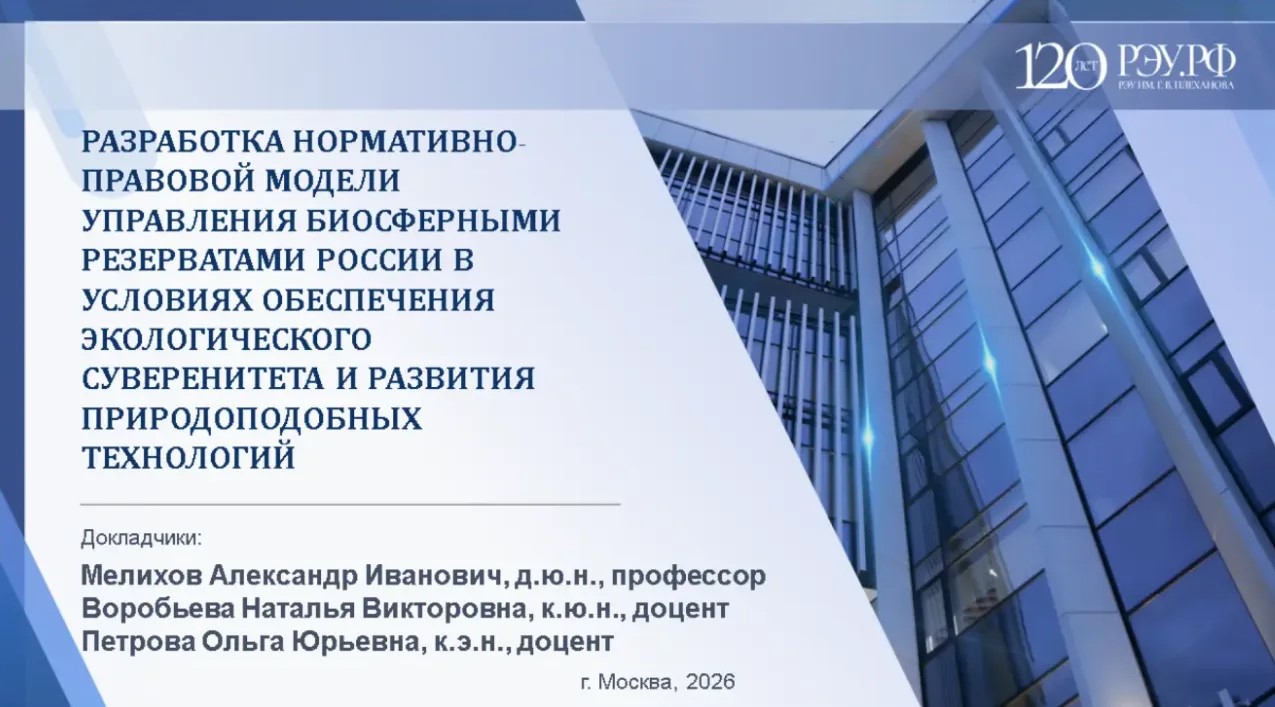
On August 5, 2026, a scheduled meeting of the research and practical development team was held at the Plekhanov Russian University of Economics, based at the UNESCO Chair "Socio-Economic Models of Biosphere Reserves." The meeting focused on creating a regulatory and legal model for managing specially protected natural areas (PNA) under conditions of ensuring environmental sovereignty and developing nature-like technologies. The session was moderated by Pavel Terelyansky, Professor and Deputy Director of the Chair. The meeting was attended by representatives of the Russia's leading protected areas: the Central Forest State Natural Biosphere Reserve; Taganay National Park; Baikal State Natural Biosphere Reserve; Altai State Natural Biosphere Reserve; Prioksko-Terrasny State Natural Biosphere Reserve named after M.A. Zablotsky; Kuznetsk Alatau State Nature Reserve; Kenozersky National Park; and Altai State Nature Reserve.
The key topic of discussion was the concept of introducing amendments to federal laws defining the legal status and zoning structure of biosphere reserves. In light of new legislative initiatives that allow for the withdrawal of lands from protected areas for federal needs, scientists proposed mechanisms for territory protection that would not only preserve ecosystems but also integrate them into the socio-economic context of the regions.
The keynote address was delivered by Professor A. Melikhov, Doctor of Juridical Sciences, of the Department of State and Municipal Administration, who substantiated the need for legally enshrining a three-zone structure for reserves (core zone, buffer zone, and cooperation zone). Associate Professor O. Petrova, the head of the research group, presented an analysis of the UN Sustainable Development Goals and their alignment with the indicators of the national projects "Environmental Wellbeing" and "Tourism and Hospitality." Associate Professor N. Vorobyeva reported on the development of educational and methodological materials for the training courses "Management of Biosphere Reserve Development" and "Environmental Management."
O. Strelkova, a member of the Commission of the State Council of the Russian Federation on Environmental Wellbeing and Editor-in-Chief of the media outlet "Ecology of Russia," emphasized the importance of synchronizing UNESCO's international requirements with the national objectives of the Russian Federation in the field of biodiversity conservation.
Representatives of the protected areas directorates supported the initiative, noting that the project provides tools for protecting the interests of UNESCO biosphere reserves in the Russian Federation and for attracting funding for the development of ecotourism and biodiversity monitoring.
Following the meeting, it was decided to continue developing the concept of legislative amendments while taking into account expert comments, to finalize the framework of interconnections between UNESCO standards and the national project "Ecology," and to submit the prepared materials for external peer review.